
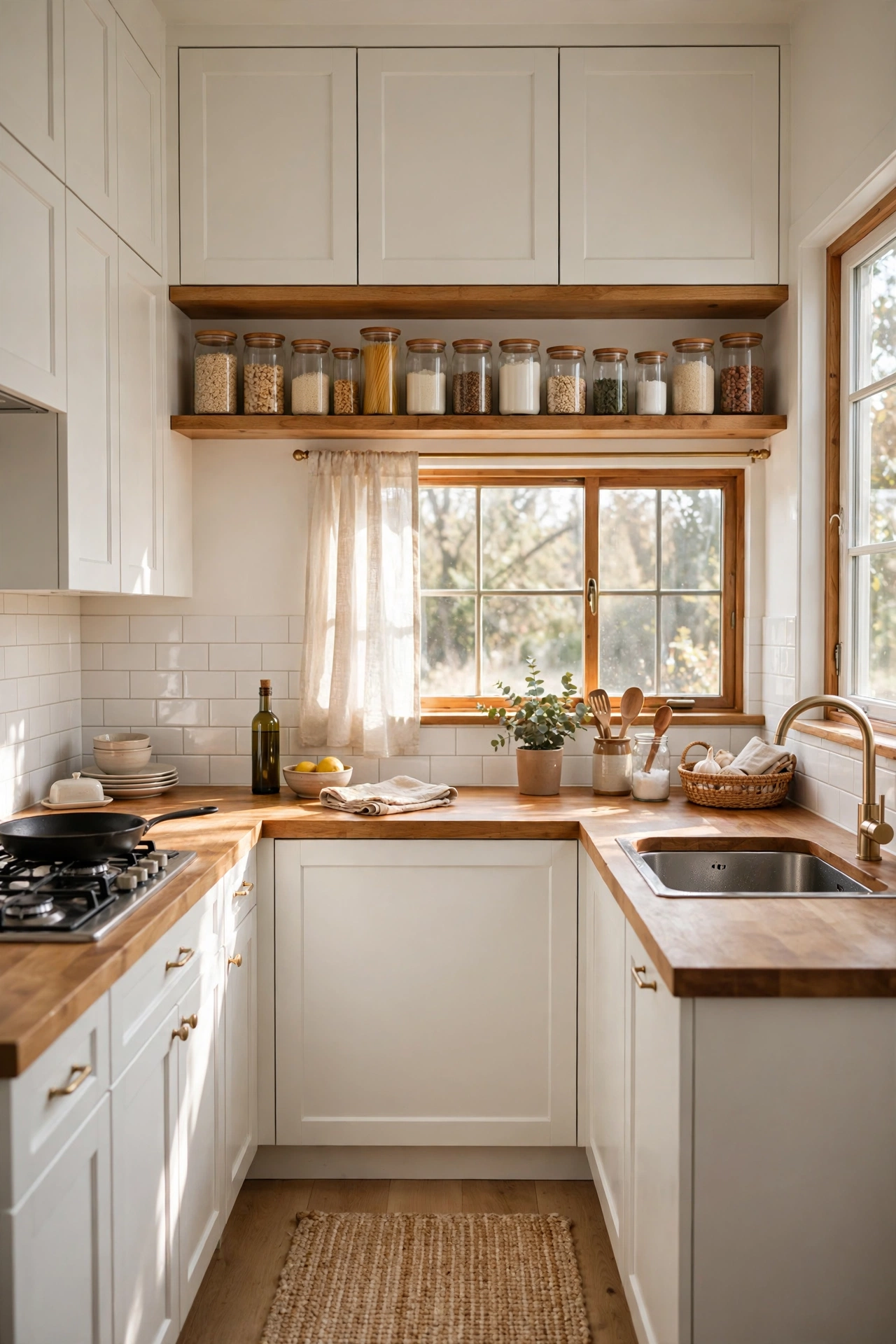
A small kitchen isn’t a curse — it’s a design challenge. And honestly, some of the most functional kitchens I’ve ever seen are the tiniest ones, because every centimetre has to earn its place.
The secret to small kitchen organisation isn’t buying more stuff. It’s making better decisions about what stays, where it lives, and how you use the space you already have — especially the vertical space most people completely ignore.
These 15 small kitchen organisation ideas are all renter-friendly, budget-friendly, and proven in real tiny kitchens. No drilling required for most of them, no renovation, and no expensive custom cabinetry. Let’s turn your cramped kitchen into a calm, hardworking space.
1. Declutter Ruthlessly Before You Organise Anything
You cannot organise clutter — you can only move it around. Before buying a single storage product, pull everything out of one cupboard or drawer at a time and sort it into three piles: keep, donate, bin.
Be honest about the duplicates. Nobody needs three vegetable peelers, two sets of measuring cups, or the bread maker gathering dust since 2019. If you haven’t used it in a year, it doesn’t deserve precious space in a small kitchen.
Budget tip: Decluttering costs nothing and instantly creates 20–30% more space. Do this first and you might find you don’t need to buy anything at all.
2. Use Your Wall Space — It’s Free Real Estate
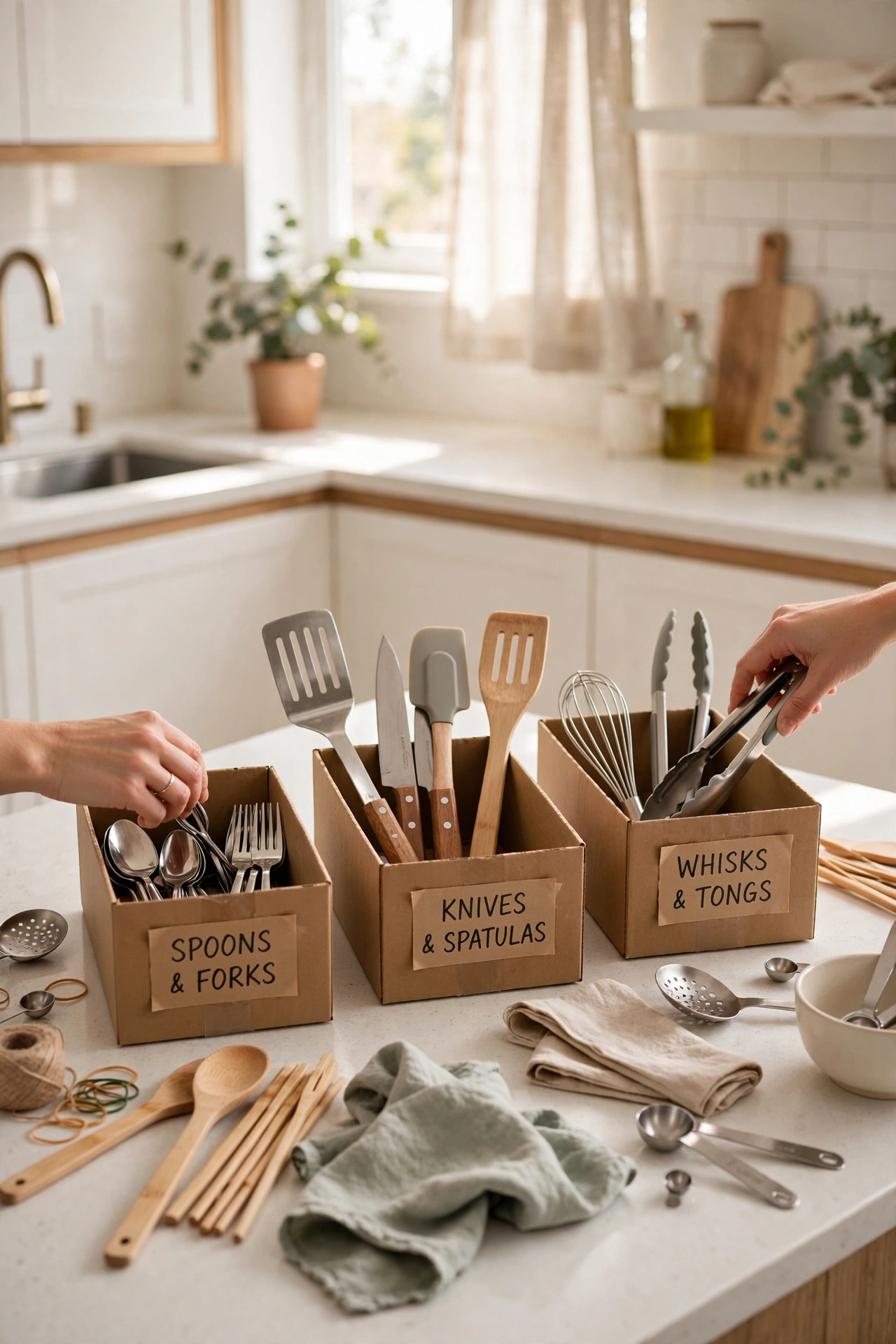
In a small kitchen, the walls are the most underused storage zone you own. A simple rail with S-hooks (the IKEA-style kitchen rail costs very little) mounted on a spare stretch of wall or splashback holds utensils, mugs, small pans and scissors — all within arm’s reach.
Pegboards work brilliantly too. A small pegboard panel lets you rearrange hooks whenever your needs change, and it keeps everyday tools visible so you actually use them.
Renter-friendly: Use heavy-duty adhesive strips or a tension-mounted rail instead of screws, and you’ll leave zero marks when you move out.
3. Add Organisers to the Inside of Cabinet Doors
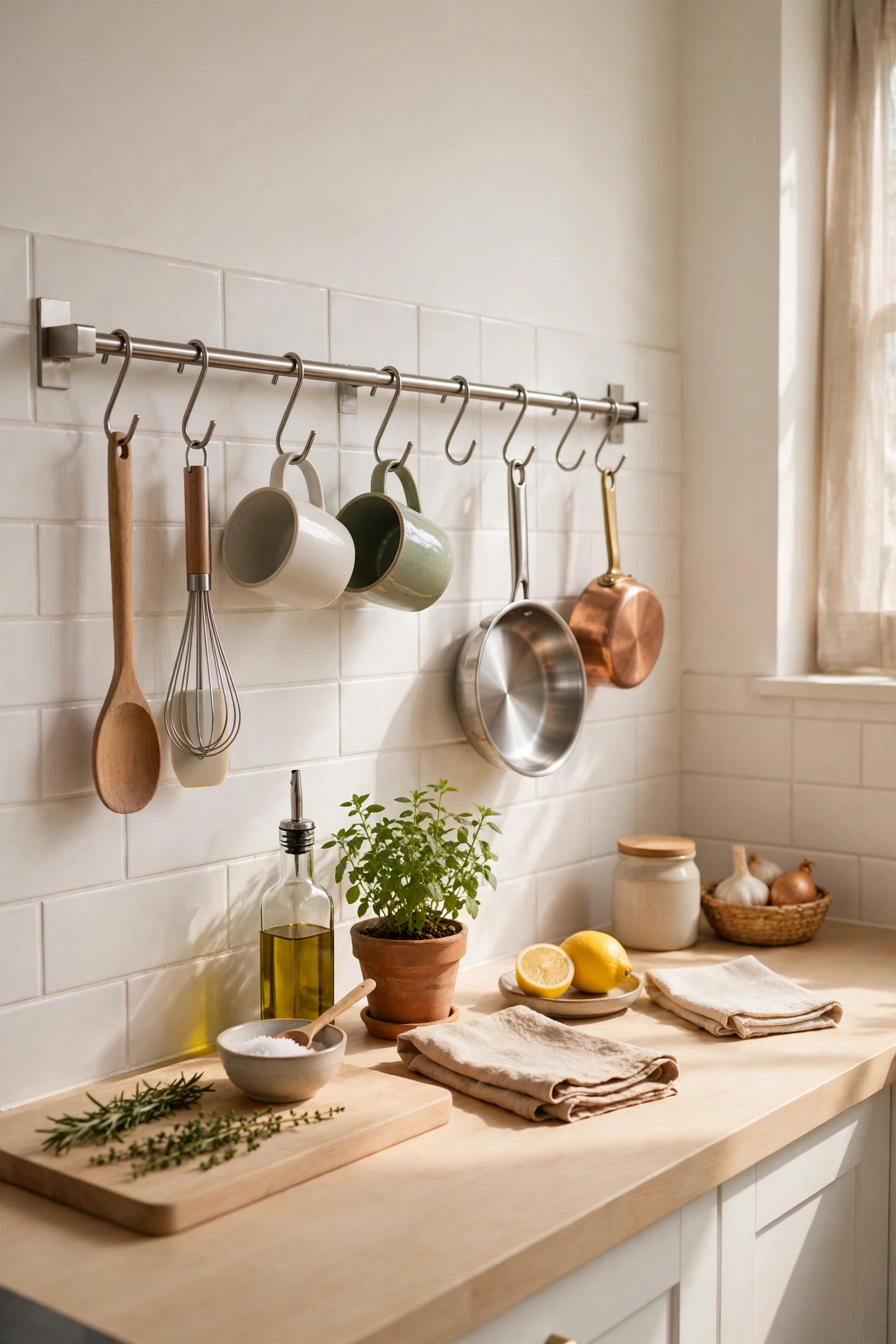
The inside of every cabinet door is wasted space in most kitchens. Slim adhesive or over-the-door racks turn it into storage for cling film, foil, spice sachets, cleaning cloths and pot lids.
Measure the depth first — you need the door to still close. Shallow wire racks (5–7 cm deep) are perfect for this and cost very little in multipacks.
Why it works: These are the small, fiddly items that otherwise end up in a chaotic “junk drawer.” Giving them a door keeps drawers free for bigger things.
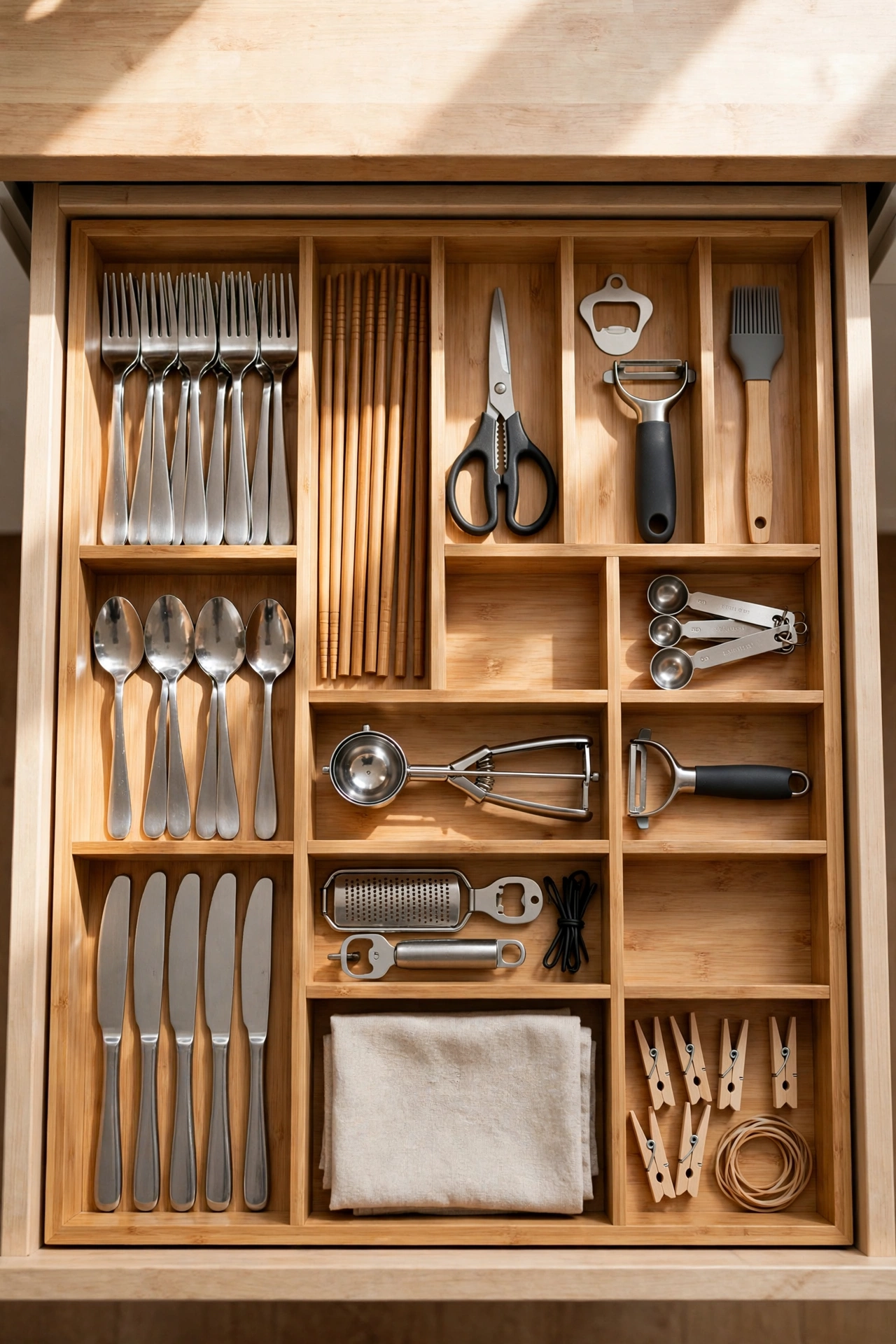
4. Divide Every Drawer With Adjustable Dividers
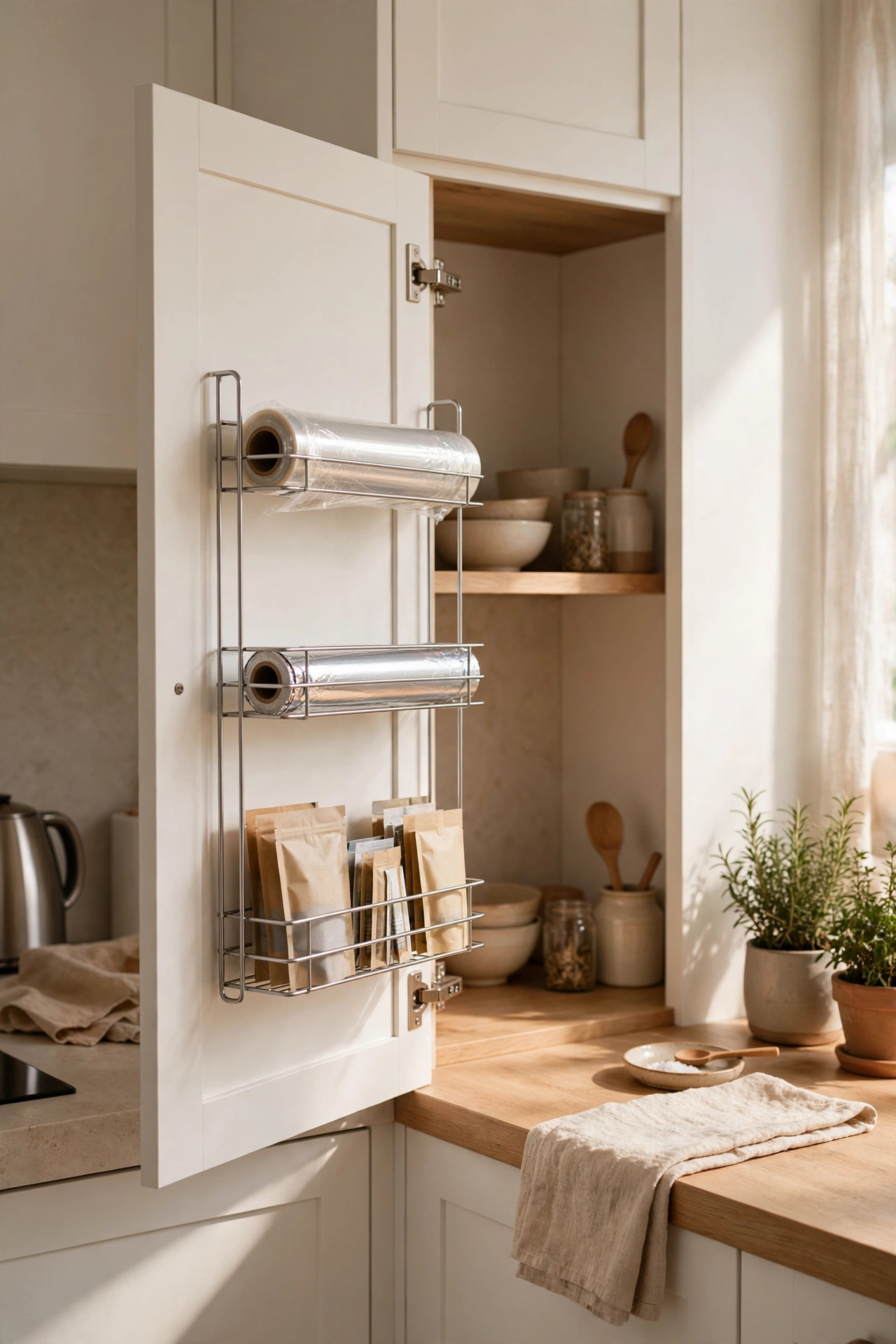
A drawer without dividers is just a box where things go to disappear. Spring-loaded or bamboo adjustable dividers cost little and instantly turn one chaotic drawer into neat zones: cutlery, cooking utensils, gadgets, and wraps each get their own lane.
For deep drawers, add a second layer with a shallow tray on top — spatulas and tongs on top, less-used gadgets below.
Small kitchen win: Divided drawers mean you stop buying duplicates of things you already own but couldn’t find.
5. Double Your Shelf Space With Tiered Shelf Risers
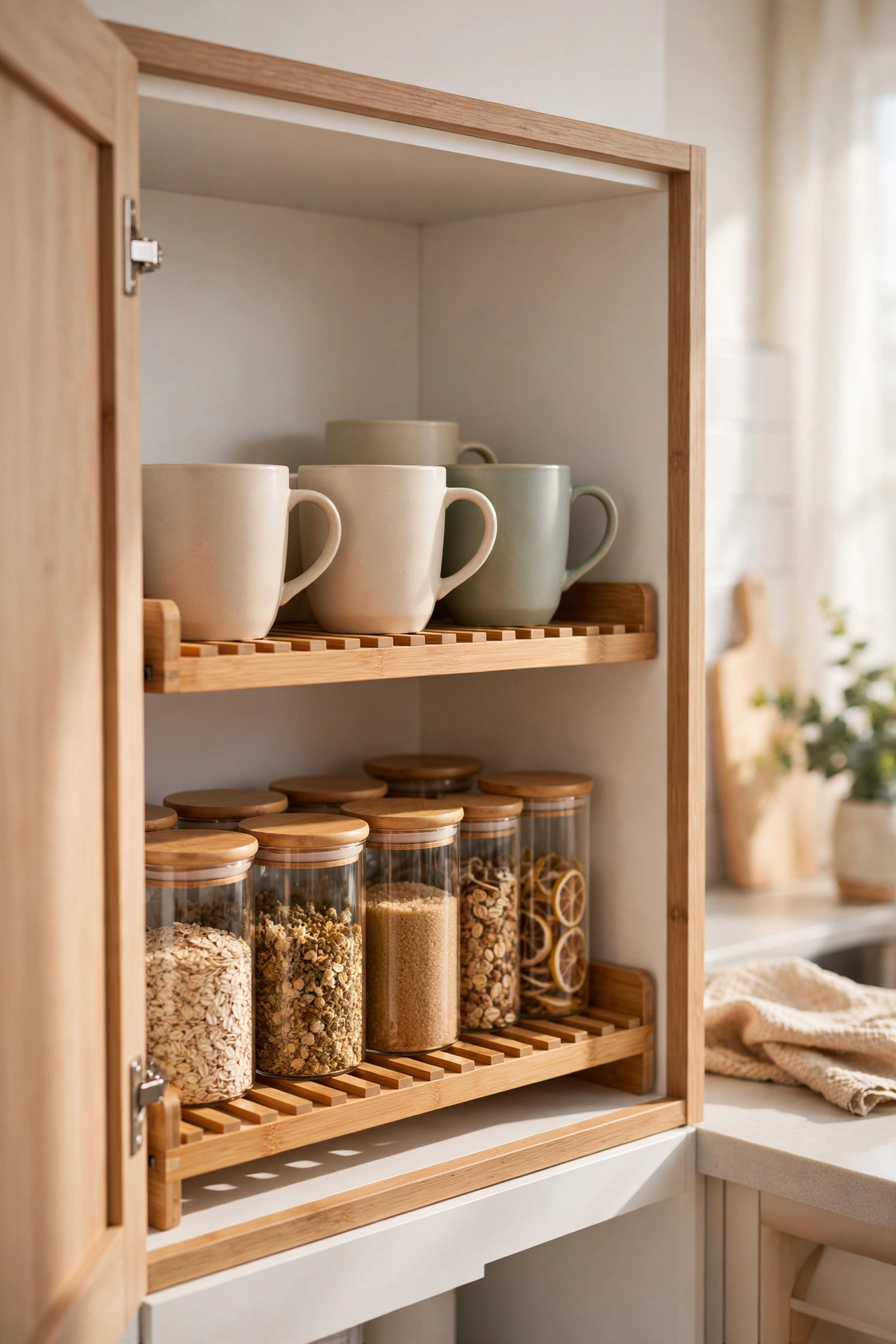
Most kitchen shelves waste the top half of their height. A tiered shelf riser (a small set of steps that sits inside the cupboard) lets you stack mugs, tins and jars on two or three levels instead of one.
They’re especially transformative in wall cabinets where short items like spice jars and mugs live. What was one crowded shelf becomes two organised ones overnight.
Budget tip: A set of two bamboo risers is one of the cheapest upgrades with the biggest visible impact. Start with your most-used cabinet.
6. Free the Counter With an Over-Sink or Roll-Up Drying Rack
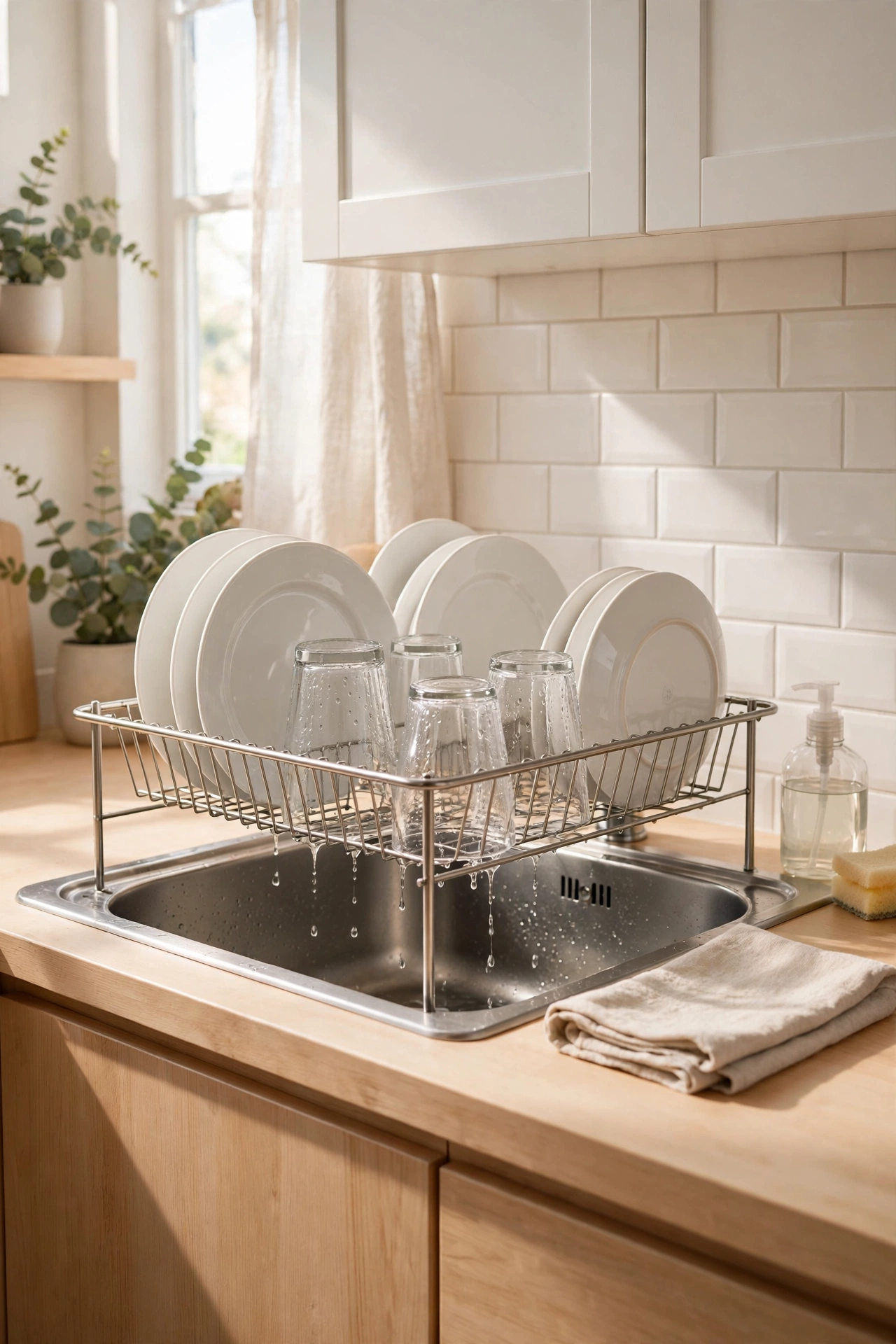
A traditional dish rack eats a huge chunk of counter space permanently. An over-sink rack sits across the sink itself, using space that was otherwise dead, and a roll-up silicone rack unrolls over the sink when you need it and rolls away into a drawer after.
Either option reclaims roughly half a square metre of counter — in a small kitchen, that’s gold.
Bonus: Dishes drip straight into the sink, so there’s no puddle to wipe up and no damp mat harbouring smells.
7. Mount a Magnetic Strip for Knives and Spice Tins
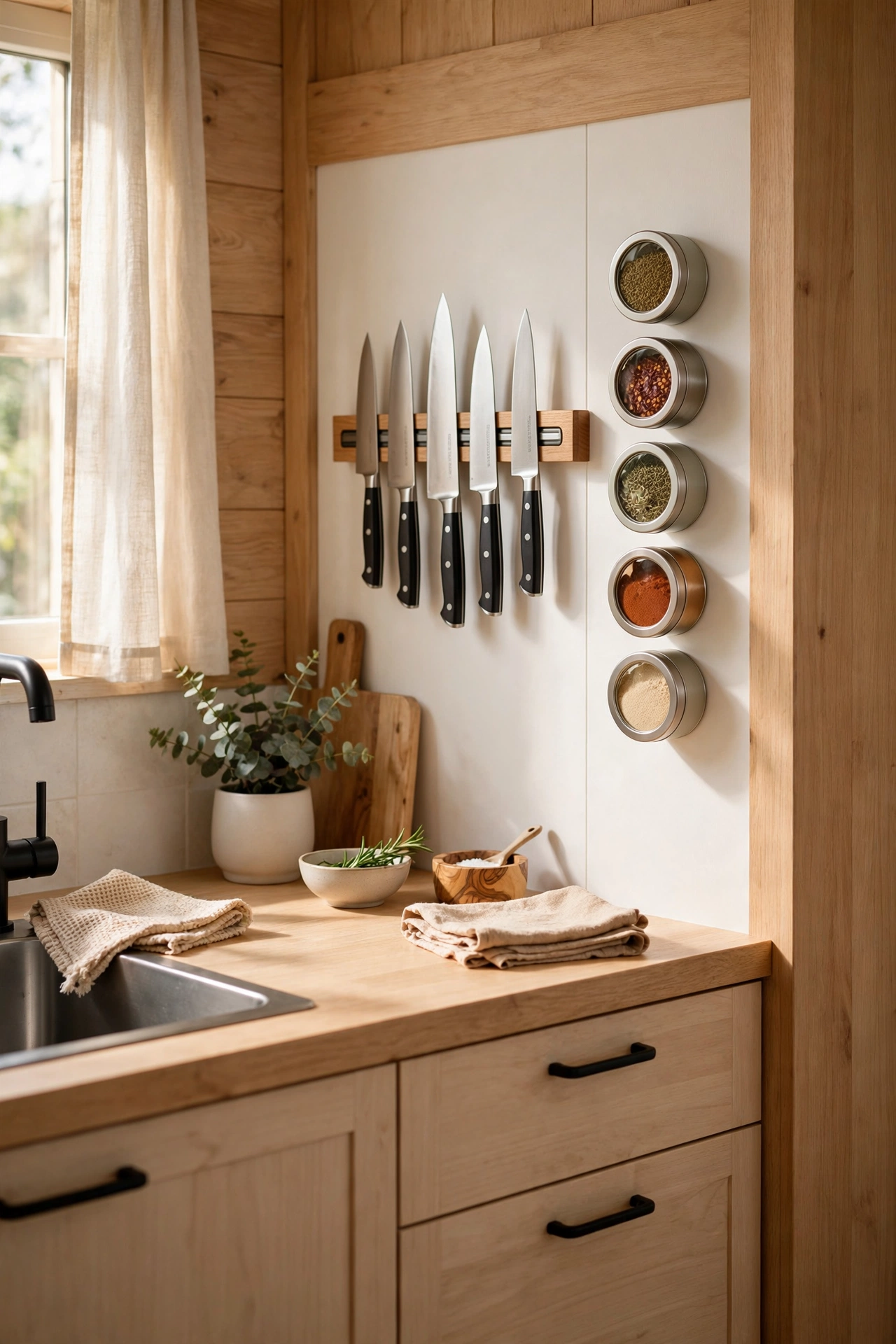
Knife blocks are counter hogs. A magnetic knife strip on the wall or inside a cabinet door holds your knives safely, visibly, and within reach — while freeing an entire corner of counter space.
The same trick works for spices: small magnetic tins stick to a metal board or the side of the fridge, turning a whole spice rack’s worth of jars into a flat wall display.
Safety note: Mount knife strips out of reach of small children, and choose a strip with a strong hold so heavier chef’s knives stay put.
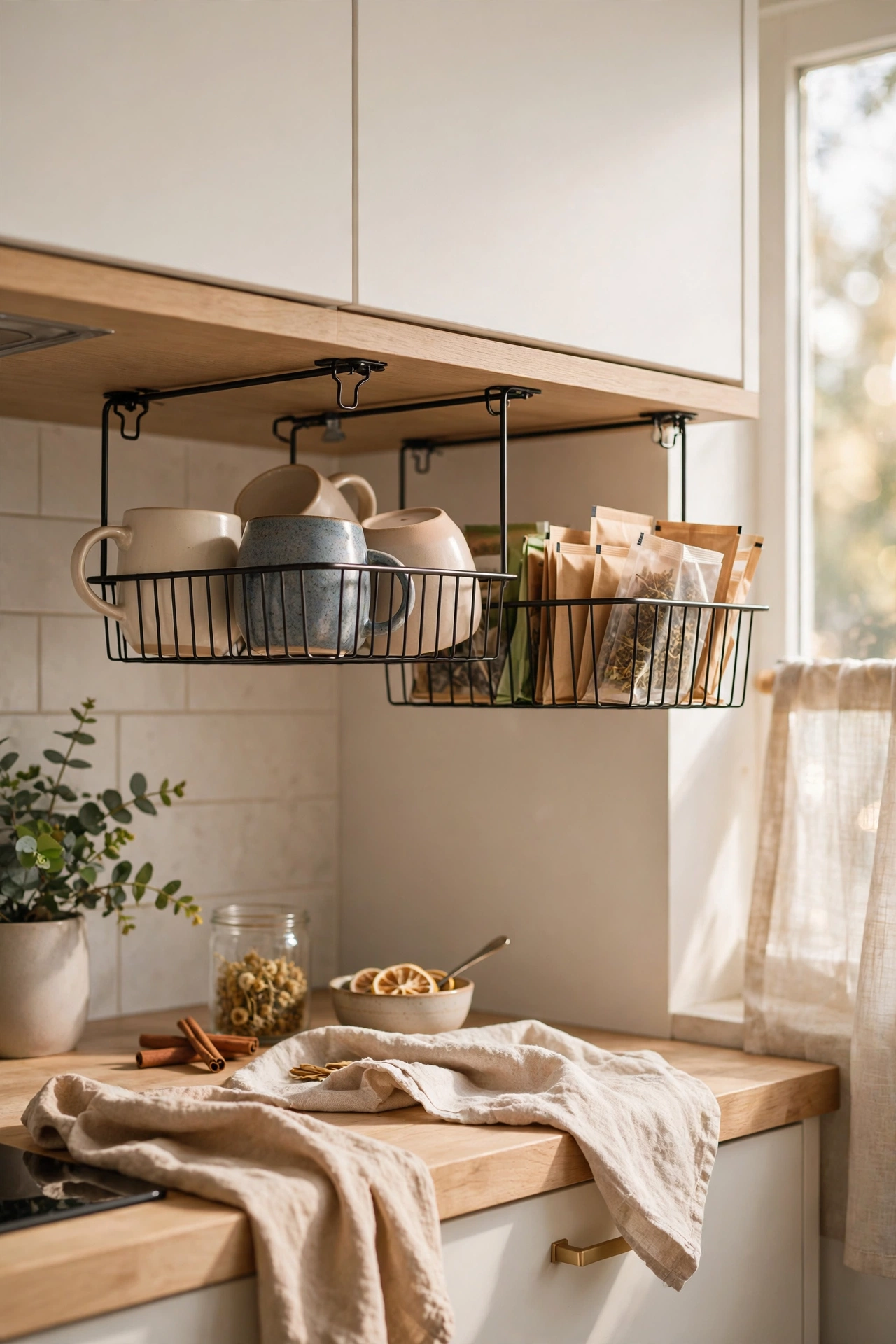
8. Clip Under-Shelf Baskets Onto Existing Shelves
Under-shelf baskets hook onto the shelf above and create a hanging second layer underneath — perfect for mugs, wraps, small bowls or packets. No tools, no screws, no damage: they just slide on.
Use them in wall cabinets for mugs (frees an entire shelf), in the pantry for snack packets, or under a desk-style shelf for tea and coffee supplies.
Small kitchen win: Each basket adds the equivalent of half a shelf of storage for the price of a coffee.
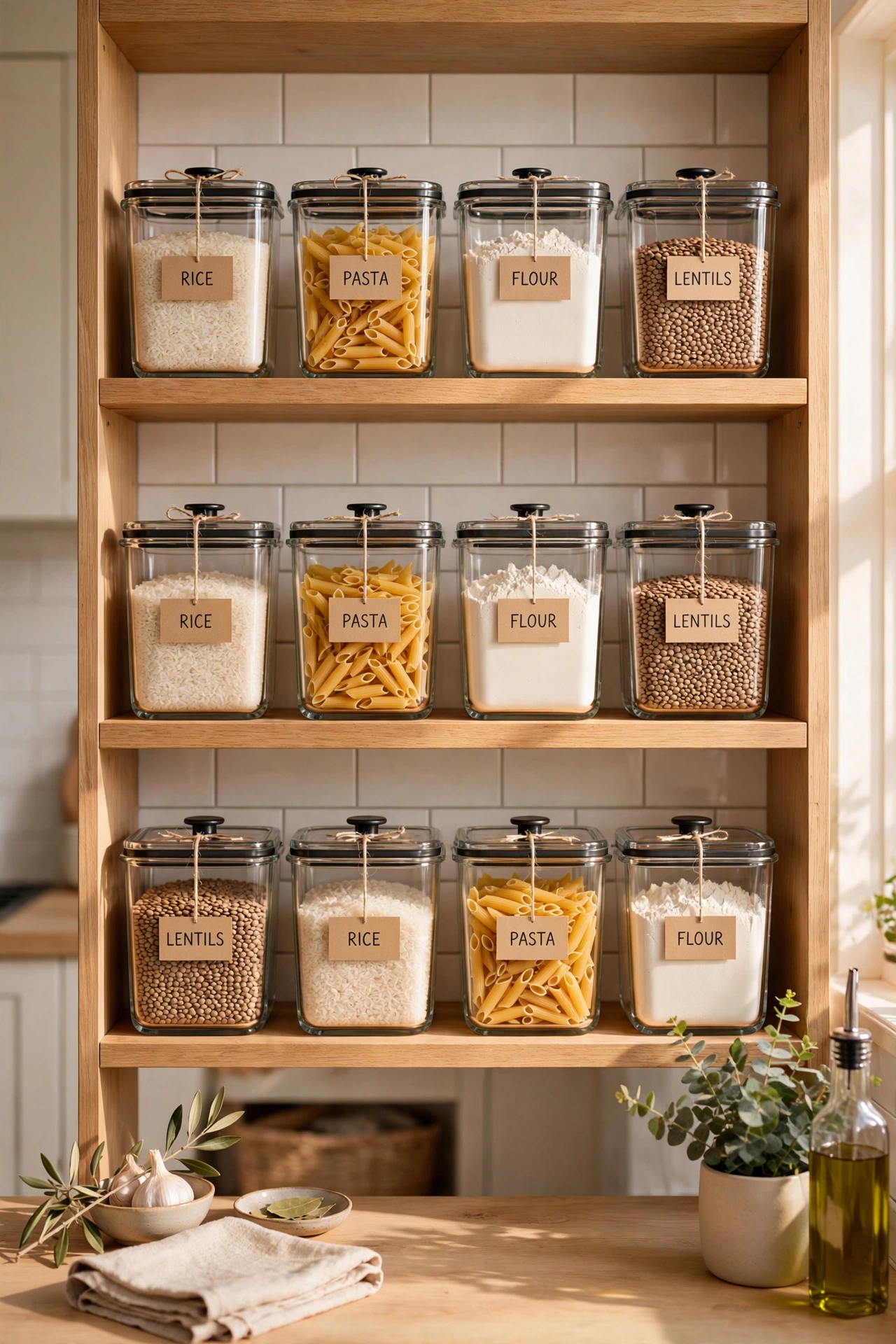
9. Decant Dry Goods Into Clear, Stackable Containers
Bags and boxes are the enemy of small kitchen organisation — they’re all different shapes, they don’t stack, and you can’t see what’s inside. Decanting flour, rice, pasta, lentils and cereals into uniform clear containers transforms a chaotic pantry shelf into a calm, stackable system.
Square containers waste less space than round ones. Buy one matching set rather than mixing brands so they stack perfectly.
The real payoff: You can see at a glance what you’re running low on, which means fewer duplicate purchases and less food waste — the containers pay for themselves.
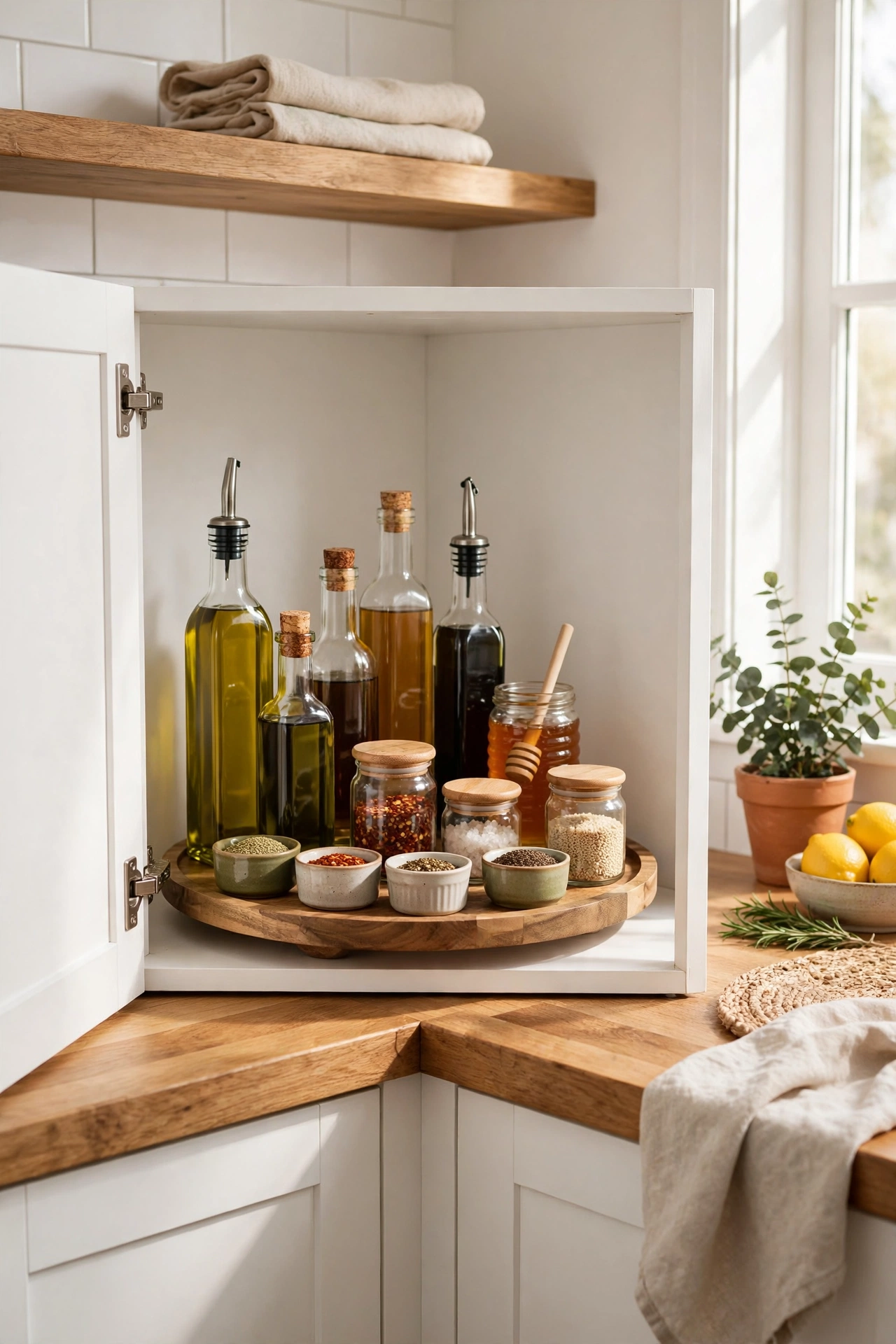
10. Tame Corner Cupboards With a Lazy Susan
Corner cupboards are where small kitchen storage goes to die — things slide to the back and are never seen again. A turntable (lazy Susan) fixes this instantly: one spin brings everything to the front.
Use a large one for pots and pans in a base corner cupboard, and smaller ones for oils, vinegars and condiments in wall cabinets. Non-slip lining stops things sliding as it turns.
Budget tip: You don’t need a fitted carousel mechanism. A simple freestanding turntable does 90% of the job for a fraction of the price.
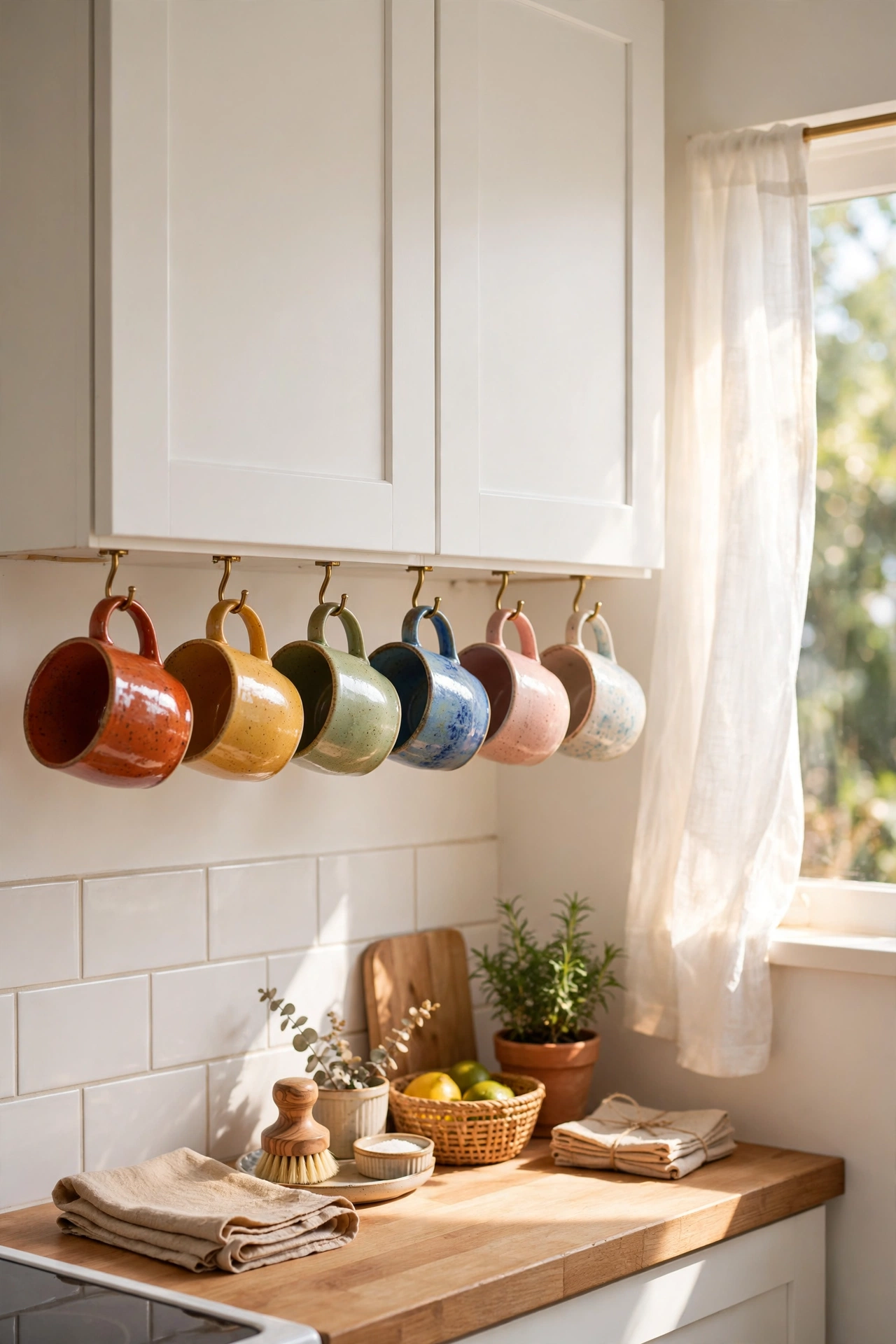
11. Hang Mugs Under Cabinets Instead of Stacking Them
Mugs are deceptively space-hungry — a stack of six eats a whole shelf. Under-cabinet mug hooks screw or stick to the underside of wall cabinets, letting mugs hang in the dead air space below the shelf.
Six mugs hanging under a cabinet free up an entire shelf for plates or food storage. It also looks charming — a row of favourite mugs becomes part of the kitchen’s character.
Renter-friendly: Adhesive-backed hooks hold mugs securely and remove cleanly. Just check the weight rating first.
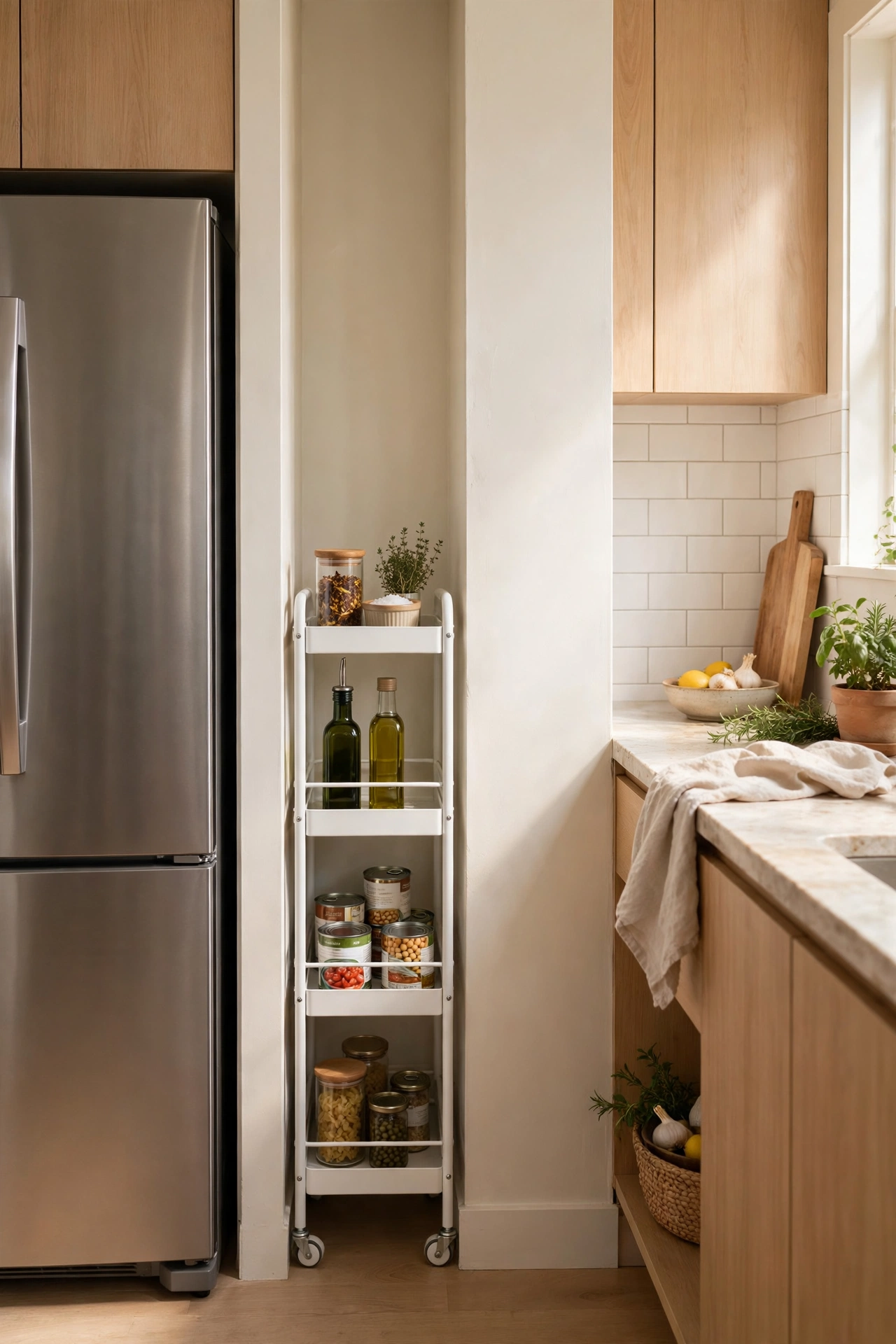
12. Add a Slim Rolling Trolley for the Gaps
Every small kitchen has dead gaps — between the fridge and the wall, beside the cooker, at the end of a counter run. A slim rolling trolley (15–20 cm wide) slides into these gaps and holds oils, spices, tins or cleaning supplies on three or four tiers.
Because it rolls out, everything stays reachable. When you need floor space back, it tucks away invisibly.
Measure first: These gaps are often narrower than they look. Measure twice, buy once — 15 cm trolleys fit most standard gaps.
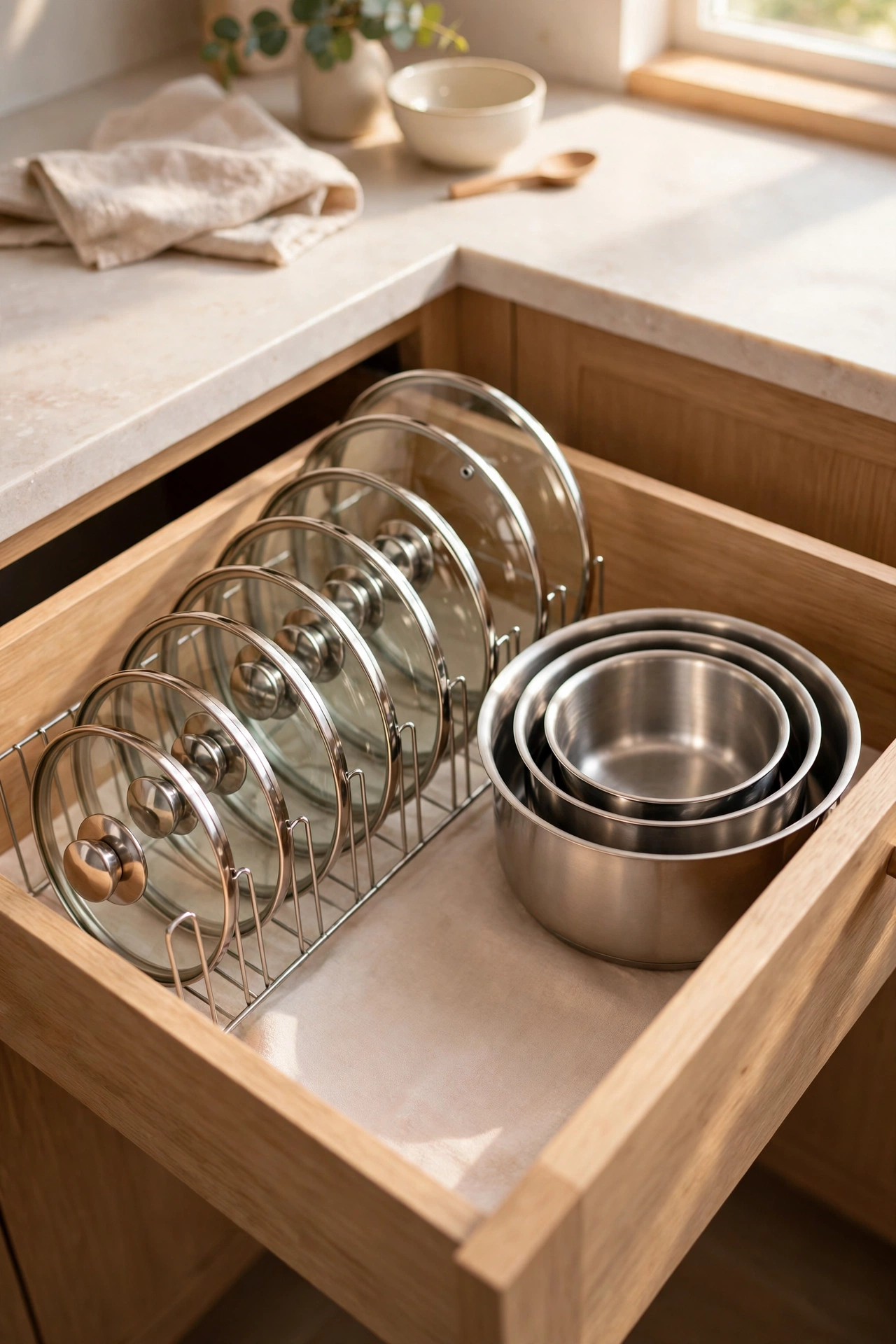
13. Store Lids Vertically, Not Stacked on Pots
Pot lids stacked on pots double the height of every pan and make the whole stack unstable. A simple vertical lid organiser — a wire rack that holds lids upright like files — lets you store lids in a narrow slot beside the pots instead.
It works inside a deep drawer, a base cabinet, or even mounted on a cabinet door. Suddenly your pots nest properly and you can actually reach the one at the bottom.
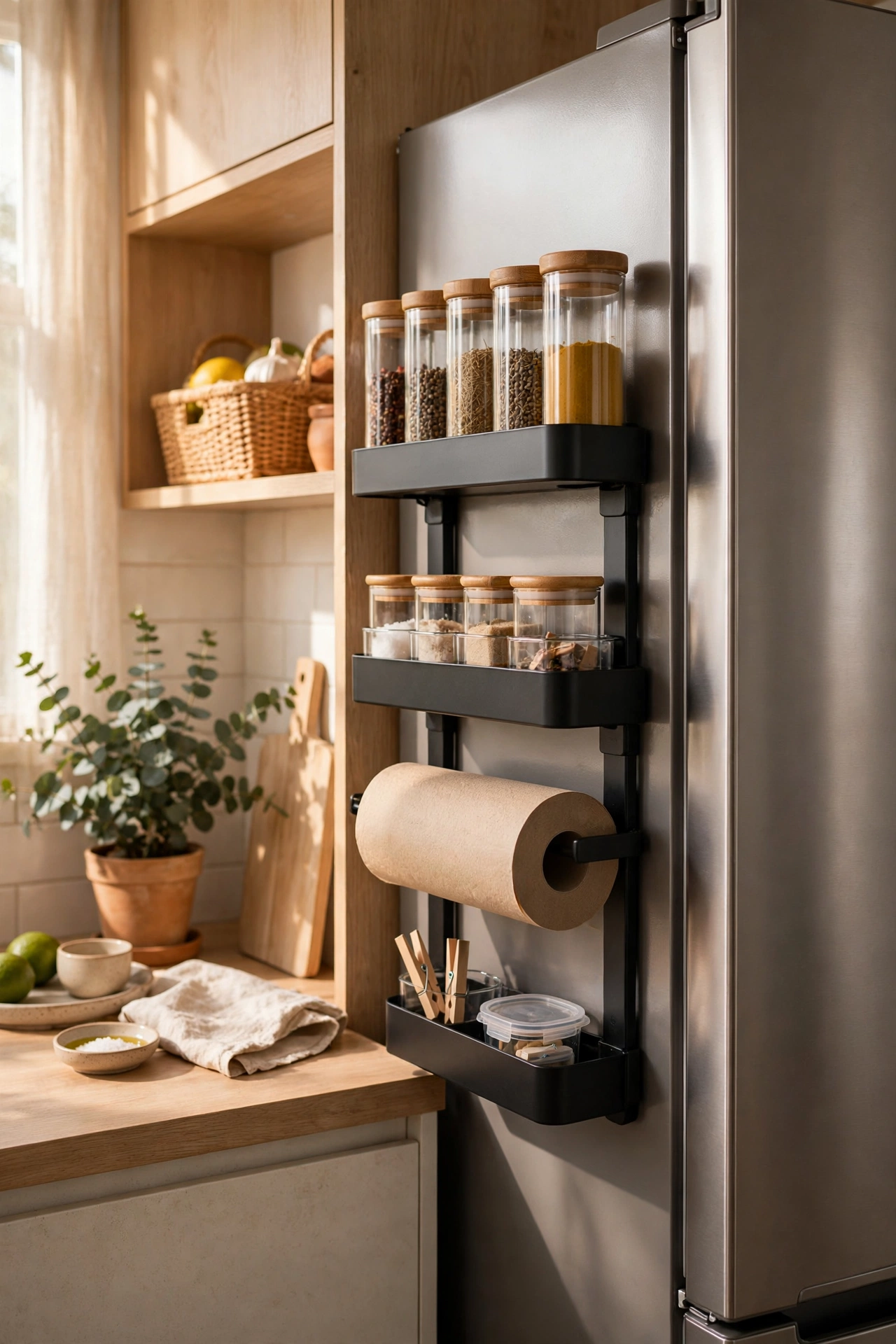
14. Use the Fridge Sides and Top as Storage Zones
The sides of the fridge are magnetic prime real estate. Magnetic shelves, paper towel holders and spice racks stick straight on — no drilling, fully removable, and they keep everyday items off the counter.
The top of the fridge is another forgotten zone: a low basket or tray there holds rarely-used items like vases, bulk napkins or the fondue set. Just keep it tidy — it’s visible.
Renter-friendly: Everything here is magnetic or freestanding, so it’s 100% damage-free.
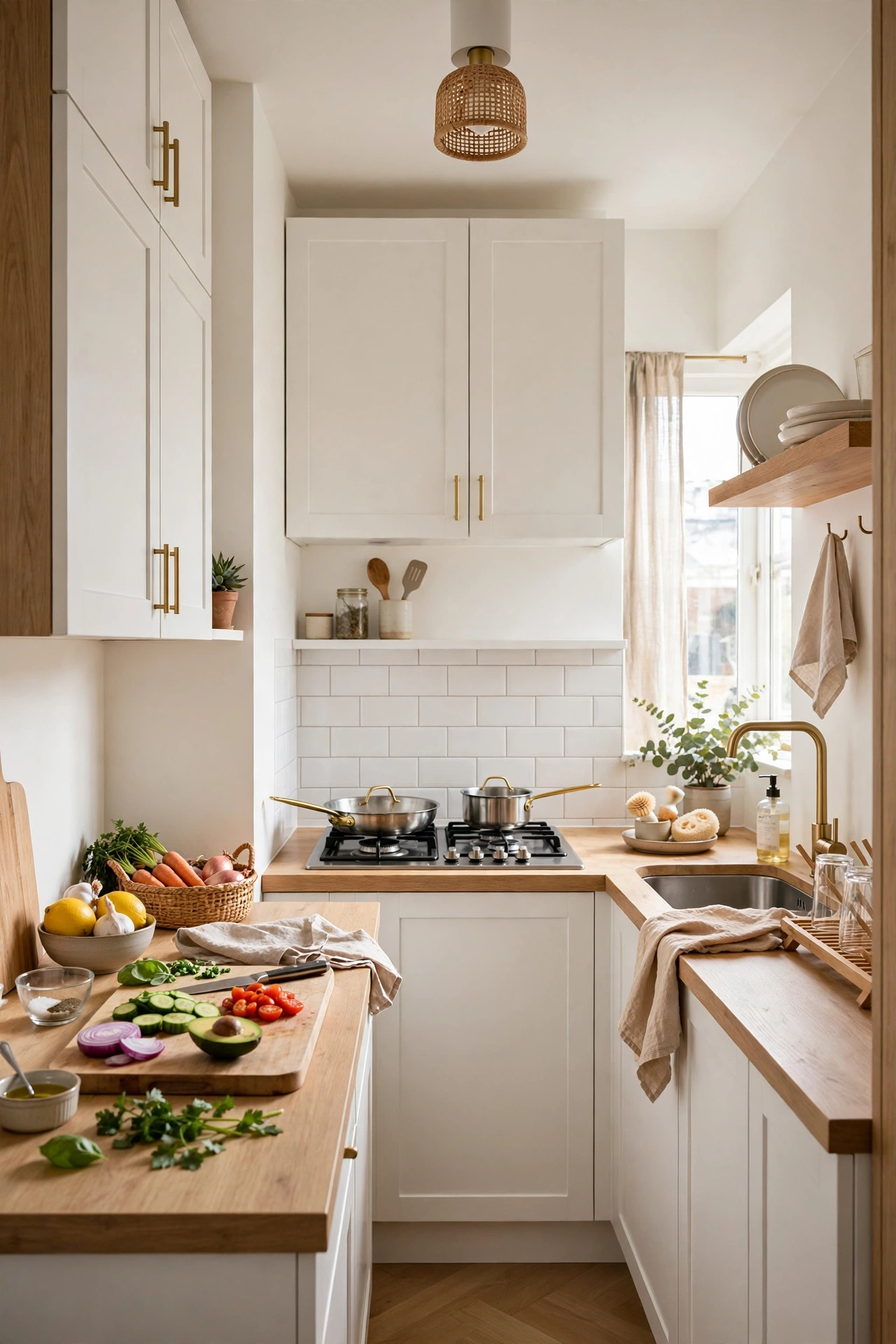
15. Create Zones So Everything Has a Home
The final idea ties everything together: divide your small kitchen into zones based on how you actually cook. A prep zone near the largest counter with knives and chopping boards; a cooking zone around the hob with oils, spices and utensils; a cleaning zone by the sink with washing-up supplies.
When every item lives in the zone where it’s used, you stop the endless criss-crossing of a small space, tidying becomes automatic, and the kitchen stays organised without effort.
The one rule that makes it stick: If something doesn’t have a zone, it doesn’t have a home — and that’s your cue to declutter it.
Frequently Asked Questions
How can I organise a very small kitchen on a budget?
Start by decluttering — it’s free and creates the most space. Then spend small amounts on high-impact items: drawer dividers, shelf risers, under-shelf baskets and a wall rail with hooks. Most of the ideas in this guide cost less than a takeaway each.
What is the best way to maximise storage in a tiny kitchen?
Use vertical space: walls, cabinet doors, under-shelf areas and the sides of the fridge. In small kitchens, the walls and doors typically hold as much potential storage as the cabinets themselves.
How do I organise my kitchen without drilling holes?
Use adhesive hooks and strips, tension rods, magnetic organisers, over-door racks, freestanding shelf risers and rolling trolleys. Every idea in this guide except the wall rail has a no-drill alternative.
How do I keep my small kitchen clutter-free long term?
Give everything a zone and follow the one-in-one-out rule: when something new enters the kitchen, something old leaves. A five-minute evening reset — putting everything back in its zone — prevents clutter from rebuilding.
Final Thoughts
Small kitchen organisation isn’t about having less — it’s about making what you have work harder. Start with the free wins (declutter, zones), add a few budget organisers where they’ll make the biggest difference, and use your walls and doors like the storage goldmines they are.
Pick three ideas from this list and implement them this weekend. You’ll be amazed how different your kitchen feels by Sunday evening.
Looking for more ways to make your home calmer and more functional? Explore our Bedroom Ideas for a peaceful sanctuary, and check back soon for living room and bathroom organisation guides.
6 thoughts on “15 Small Kitchen Organisation Ideas That Save Counter Space (on a Budget)”